

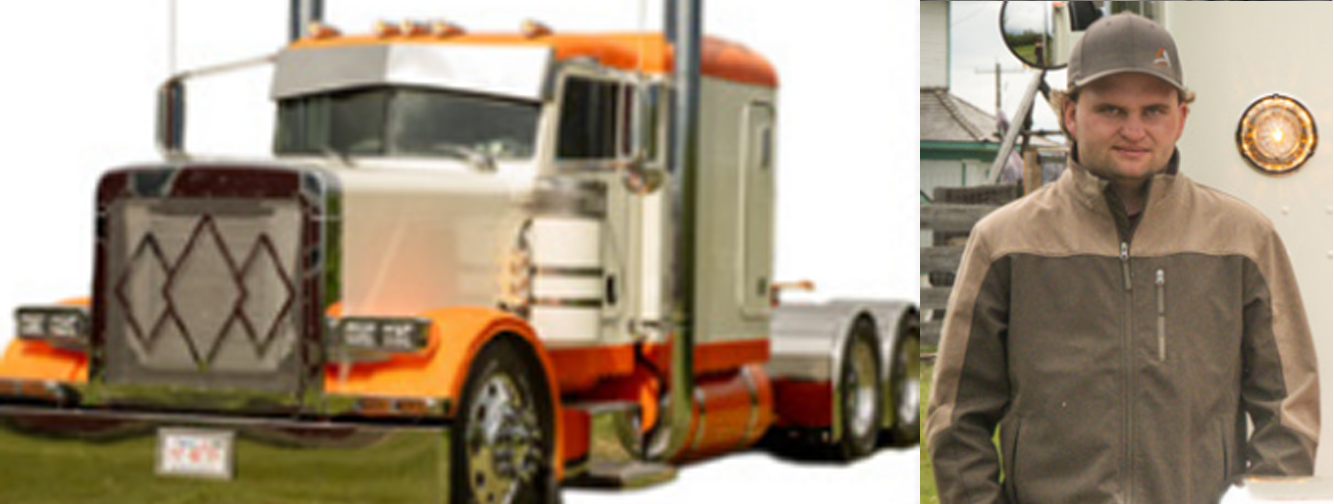
September-October 2026 – Ty Appleyard
I was born and raised on our family farm northeast of Strathmore, Alberta. Agriculture has always been a big part of my life, so growing up meant being around cattle, grain, trucks and equipment from a young age.
Trucks were always coming and going from our yard, hauling cattle, grain, bales, or equipment depending on the time of year. I was drawn to them and always paid attention to what they were hauling when one pulled into the yard, where it was headed, and watched the drivers maneuver into our cattle chute, which wasn’t exactly in the most convenient spot. I’d even throw on my boots and run out the door to help guide them in. Looking back, I’m pretty sure none of them actually listened to my directions, but at the time I was convinced I was making all the difference. As I got older, watching from the sidelines naturally turned into wanting to get behind the wheel myself.
Trucking and agriculture have always gone hand in hand for me. Many of my family members and close friends have their Class 1 licences, so trucks were simply part of everyday life growing up. Being surrounded by people who drove them made it feel natural that, eventually, I would too.
My dad, Greg Appleyard, was the one who taught me to drive. He knew I had an interest in trucks and equipment and gave me the opportunity to learn from a young age. We had plenty of both around the farm, so there was never a shortage of opportunities to get some experience. The first big truck I drove was a Kenworth T800. Like most things when you’re young, I was probably a lot more confident in my abilities than I had any reason to be.
My dad has also been the person I’ve looked up to most throughout my life. I grew up watching him work hard, expand our farming and cattle operation and build other businesses along the way. He gave me plenty of opportunities, but he also made sure I understood that having an opportunity and earning your place are two different things.
I got my Class 1 licence in 2021. By then, the new training requirements had made getting a licence quite a bit more involved than it had been previously. But the driving portion wasn’t what worried me. The written test was. I never particularly enjoyed school, and sitting down to study for a written test wasn’t exactly my idea of a good time. I would have much rather been outside actually driving the truck. Turns out being able to drive the truck and being able to pass a test about driving the truck are two very different skill sets. The written portion probably caused me more grief than anything else in the process, but I eventually got through it and got my licence.
Once I had my Class 1, I was able to do more trucking for our family operation and also started driving for Westland Livestock out of Acme, Alberta. That became an important part of my experience because it got me outside of our own operation. I was able to haul commercially, gain experience on my own and learn from people who had been in the industry much longer than I had. At Westland, I worked with Eric Hempel and Rodney Ratzlaff, and I couldn’t have asked for two better people to work alongside. They quickly became more like brothers than coworkers, which was a big part of why I enjoyed my time there so much. We worked hard, but there was never a shortage of joking around or giving each other a hard time, which made even the longest days a lot more enjoyable.
Livestock hauling doesn’t exactly come with a predictable schedule. Days start early, end late and rarely go exactly according to plan, so the people you’re working with can make all the difference. Eric and Rodney treated me like one of their own, taught me a lot and gave me the opportunity to gain the kind of experience you can only get by actually doing the job. I have a lot of respect for both of them and for Westland, and I still recommend them whenever I get the chance.
Spending more time on the road also gave me a different perspective on driving. You don’t fully appreciate some of the decisions people make around trucks until you’re the one behind the wheel of one. People will cut in front of you, sit in your blind spot or pull out in front of you and then take their sweet time getting up to speed. Apparently, the large truck coming toward them at highway speed isn’t always enough of a hint that maybe now isn’t the best time to pull out.
Then there are the less exciting parts of trucking: scales, inspections, paperwork and regulations. I definitely wasn’t standing in the farmyard as a kid dreaming about logbooks and pulling into scales, but they’re part of the job. You learn pretty quickly that driving the truck is only one piece of it.
Today, I do most of my trucking for our family operation, Appleyard Land and Cattle. With our operation heavily involved in both cattle and grain, there is always something that needs to be hauled and rarely a shortage of time behind the wheel.
My mom spent most of her life running the cow-calf side of the operation and is easily one of the hardest-working people I know. I grew up watching her put in long days and do whatever needed to be done, regardless of the weather or time of year. Dad focused on continuing to grow the farm and cattle businesses while also starting Agra Risk Solutions, an agricultural risk management company.
I also have a twin sister who works in the family operation. We are a close family, although my sister and I ended up being interested in very different sides of the business. My main focus is trucking logistics and equipment operations. If there is a truck, tractor, loader, combine, chopper or another piece of equipment that needs to be run, that’s usually where I’ll be. My sister works more on the office side, dealing with data, budgets and numbers. Personally, I can’t imagine anything more boring, which is probably exactly why we work so well together. We each have our own lane, and I’m more than happy to let her stay in hers while I stay out of the office.
Growing up on a farm also teaches you pretty quickly that operating equipment and maintaining it are two parts of the same job. Equipment gets used hard, and things break—usually when you’re busiest and least interested in fixing them. Over time, you learn to notice when something doesn’t sound or feel right. Looking after equipment properly saves a lot of trouble later, and I’ve always taken pride in keeping the things I operate in good condition.
That is especially true when it comes to the truck I drive now. It’s a 1994 Peterbilt 379 with a 60 Series Detroit, an 18-speed transmission, 3.55 gears and 38 rear ends. The truck means a lot more to me than simply being something I enjoy driving. It was originally my dad’s truck, and I rebuilt it from the frame up. I spent countless hours taking it apart, going through everything, and slowly putting it back together the way I wanted it. One thing I made sure to keep was the original paint colour. I wanted to make the truck my own, but I also wanted it to still look like the truck I remembered as Dad’s.
There were definitely times during the rebuild when I questioned why I had taken on such a big project, but seeing it back on the road made all of those hours worth it. Because it was my Dad’s truck, there is a history behind that Peterbilt that I wouldn’t have with something I simply went out and bought. I don’t think I could buy a new truck that would mean nearly as much to me as that 379 does.
One of the things I like most about trucking is that no two days are quite the same. Every truck is a little different, every load handles differently and there’s always something new to learn. I also like the independence that comes with it. Once you’re on the road, you have a job to do and you’re responsible for getting it done properly. I’ve always preferred that kind of work over sitting behind a desk all day. That’s probably obvious considering my opinion of my sister’s job.
Agriculture as a whole has been a good life for me. It isn’t always easy, and it definitely isn’t a nine-to-five job. There are long days, busy seasons, breakdowns, bad weather and plenty of things that don’t go according to plan. Every once in a while, someone also decides to drive somewhere they probably shouldn’t, which usually brings out one of my grandpa’s favourite sayings: “Don’t drive where the ducks swim!” Unfortunately, that advice is usually remembered about five minutes too late. Some days it feels like everything decides to break at once, the plan changes three times before lunch, and you start to wonder why you bother. Usually, you complain about it for a while, fix whatever broke, come up with a new plan and get back to work. Then the next morning, you get up and do it all over again.
Overall, though, I wouldn’t change much. I like working with my family. I like being around cattle. I like trucks and equipment, and I like having work where no two days are exactly the same. I’ve also been fortunate to meet and work with people I genuinely respect and enjoy spending time with. Some of the best relationships I’ve made have come from agriculture and trucking
A lot of the way I approach work comes from Dad. He taught me to work hard, take care of what I was given and take pride in what I do. More importantly, he taught me that if you’re going to do something, you should do it properly.
Trucking will continue to be a major part of my role within our family operation. As Appleyard Land and Cattle has grown, so has the amount of logistics required to keep everything moving. Between the cattle, grain, feedlots and farming operation, there is always something going somewhere.
At the end of the day, I don’t have a complicated explanation for why I like trucking. I grew up around it, and I enjoy driving. A perfect day to me is sitting behind the wheel with some music playing, heading down the road to pick up or deliver the next load. I grew up watching trucks come and go from our farm, knowing that eventually I wanted to be the one behind the wheel. These days, that’s where I spend most of my time, and I can’t think of anywhere I’d rather be.